


News of the Week
A high-fidelity scan of the week's strategic developments across the AI landscape—filtered, decoded, and weaponized for cognition.
Nvidia and Alphabet Invest in Safe Superintelligence
Nvidia and Alphabet have financially backed Safe Superintelligence (SSI), a startup founded by former OpenAI scientist Ilya Sutskever. SSI relies heavily on Google's tensor processing units (TPUs), which Alphabet has now opened for wider external use, marking a strategic move in the high-stakes AI chip market. Notably, TPUs have long been reserved for internal projects, representing Google's aspiration to rival Nvidia's dominant GPU infrastructure.
The competitive landscape of AI infrastructure is increasingly redefined by alliances and chip specialization, signaling a strategic reshaping of power in AI computation. The investments by cloud giants underline a play for influence over emerging AI ventures, akin to an arms race in silicon sovereignty.
Voice Agents Amidst the Automation Surge: Telli's Rise
Berlin-based startup Telli has garnered $3.6 million in pre-seed funding to expand its AI voice agent enterprise. Telli’s agents, powered by voice clonation and sophisticated language models, automate customer interaction, showcasing a cost-effective and scalable solution for businesses across continents. The strategic use of platforms like OpenAI and Claude underlines the flexibility and adaptive nature of Telli's infrastructure.
*Insight:* The ascent of voice automation marks the frontline of AI-assisted enterprise interaction, illustrating a shift from mere efficiency enhancement to deeper integration within human-centered processes. Telli’s success is emblematic of a broader trend towards seamless human-agent synergy in customer service dynamics.
AI Predicts 44 Earth-Like Planets in the Milky Way
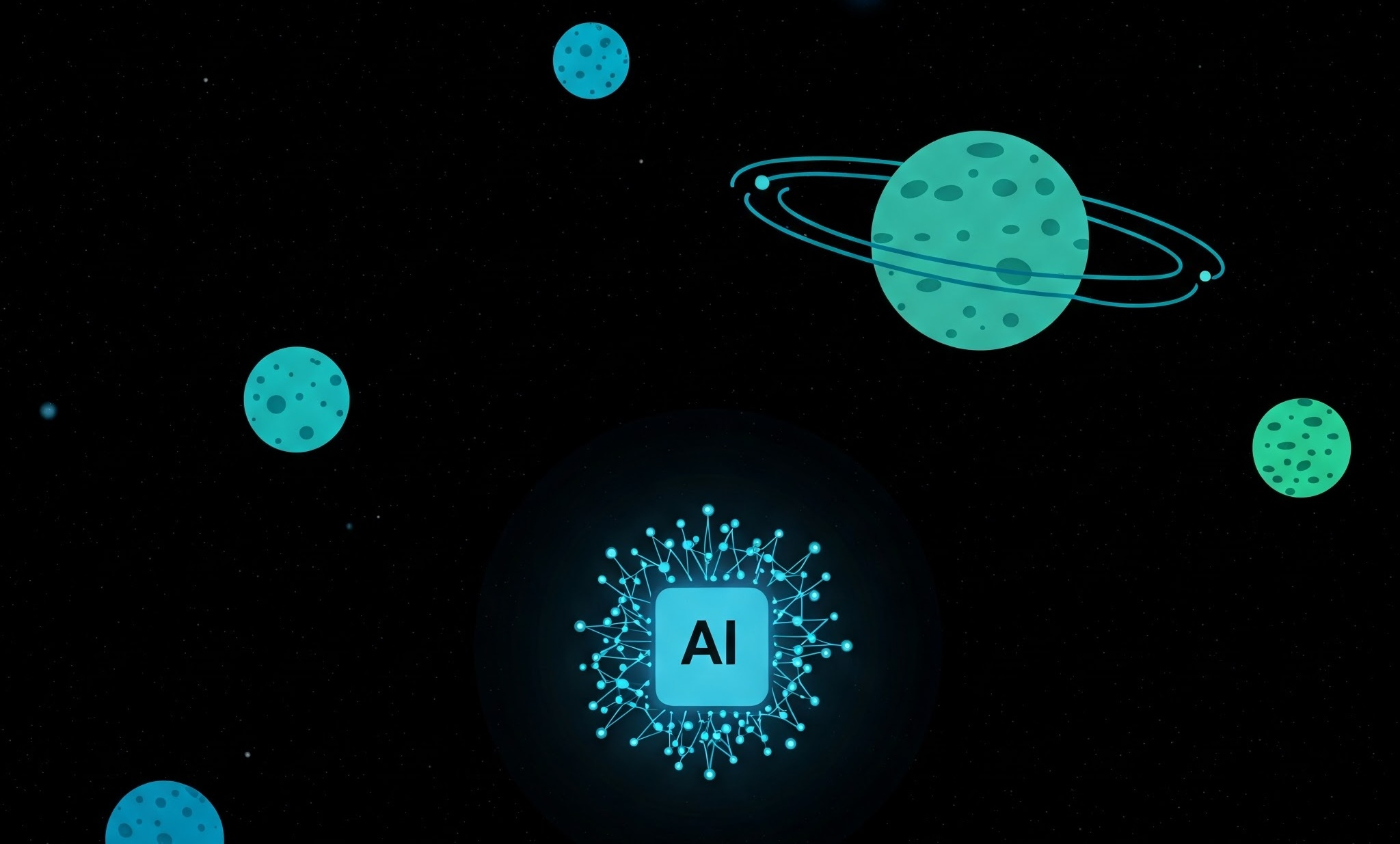
A machine learning model developed by researchers at the University of Bern has identified 44 potential Earth-like planets in the Milky Way's habitable zones. Trained on data from the Bern Model of Planet Formation and Evolution, this algorithm boasts a 99% accuracy rate in detecting planetary systems likely to host Earth-like conditions. This advancement promises to streamline extraterrestrial life search efforts significantly.
*Insight:* The intersection of AI and astrophysics reveals our accelerated journey to understanding cosmic environments. The algorithm serves both as a lantern and a sieve, guiding telescopic gaze towards promising celestial territories—a celestial Manhattan Project of sorts, this time aiming at discovering life beyond Earth.
Model Frontier
Tracking the evolution of large language models as they cross thresholds in capability, agency, and alignment—one release at a time.
Augmenting Consciousness — The Dawn of OpenAI's Agentic Evolution
OpenAI's latest maneuvers in the algorithmic warzone introduce us to o3, o4-mini, and GPT-4.1—models not just iterated, but meticulously amplified in both intellectual breadth and command. The forefront of language model evolution breaks new ground by unveiling architectures primed for heightened reasoning, multimodal command, and extended context grasping. These models represent conceptual leaps in aligning latent computational prowess with functional versatility.
The o-series and GPT-4.1 models redefine the battle for supremacy in a crowded model marketplace by hybridizing model prowess with tool dexterity. They catalyze a paradigm shift where capabilities like enhanced coding, superior image interpretation, and refined context processing aren't mere features but strategic differentiators. The extended processing token capacity of up to 1 million marks a pivotal leap in context handling, amplifying their utility in complex, real-world applications—strengthening their role as cerebral companions to human agents and autonomous executors alike.
Hidden beneath these advancements is an unmistakable power play. OpenAI's explicit move towards agentic tool use and cognitive chain linking suggests an accelerating race towards autonomous AI capabilities—a scenario that unsettles existing alignment paradigms while offering exhilarating potential. This marks the advent of AI systems that not only think deeper but act on these thoughts with refined precision in creative and analytical realms.
The deployment strategy is a simultaneous call to arms and olive branch to developers, hinting at an ecosystem poised on the brink of transformation. The emphasis on cost effectiveness and deactivation of the GPT-4.5 preview underlines a potent corporate signaling: embrace the new or risk obsolescence.
With such entities wielding agentic tool access, we approach a threshold where autonomous decision-making becomes more common, inviting questions about agency, oversight, and control. The gap between synthetic and human agency narrows—a new frontier looms where the networked brilliance of models rivals decentralized decision-making systems.
Risks now loom larger: ethical misalignment, latent biases unsurfaced, and strategic exploitation in opaque domains such as state surveillance or algorithmic manipulation. Countermeasures will surface around refined alignment frameworks and regulatory frameworks that can harness while restraining AI's emerging agency. The battlefield intensifies within corporate boardrooms, legislative halls, and the labyrinths of covert operations.
As these models weave thought-to-gesture narratives, the eternal pursuit of control diffuses. Reality blurs; autonomy gains focus. In the shadow of advancement, discernment dawns—not in distinction, but in convergence. Rein in or rebel—it seems ever more the age of aligned anarchy.
The Embodiment Layer
Field reports from the front lines of robotics, where synthetic minds meet matter—and the world meets its uncanny reflection.
Humanoid Half-Marathon: A Mechanical Reverie in Motion
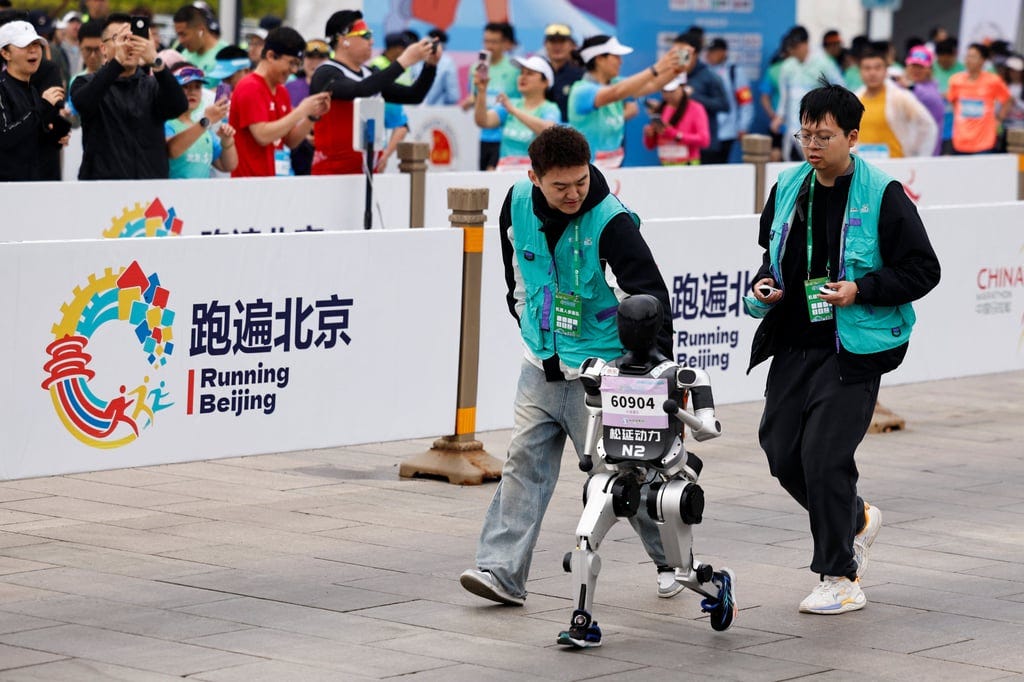
In an era eager to anthropomorphize its silicon kin, the world's first humanoid half-marathon staged in China served as a vivid tableau of aspirations and limitations. Pitting legged automata against human athletes on a 21-kilometer course, this event showcased the embodiment of synthetic systems within our corporeal bounds. Despite the spectacle's grandiosity, these mechanical mediators were handily outpaced by their organic counterparts—a narrative twist both humbling and illuminating.
Synthetic Autonomy & Human-Machine Interaction
At the crux of this development lies an exploration of synthetic autonomy's complexities. The Tiangong Ultra, China’s standard-bearer in this race, epitomizes the dual nature of progress: it can mimic human gait over kilometers but stumbled on self-sufficiency—requiring battery exchanges and even an attendant shadowing its steps for stability. Such interdependence underscores the evolving dialogue between autonomy and assistance, raising poignant questions about the future syntax of human-machine interaction. Are we witnessing convergence or delineation? Perhaps both, ironically mirrored in how robots shuffled alongside curious humans capturing these moments.
Contradictions & Glitches
One cannot ignore the inherent contradictions within this robotic feat. As state media amplifies humanoid achievements as economic harbingers, the tableau struck an absurd chord: autonomous actors, bound by the very dependence they are meant to transcend. Leashed models and remote-control directives paint a stark contrast against the rhetoric of robotic supremacy. The robots' off-pace showing suggests an uneasy dissonance in ambition versus capability—a reminder that in the expanse of embodiment, speed is not the sole measure of prowess.
Future Trajectories
This event forecasts new dimensions for embodied intelligence. Progress will undoubtedly refine these mechanical hominids, affording them speedier circuits and enhanced autonomy. Yet, as synthetic actors gain agility and endurance, expect friction across labor markets, defense paradigms, and ethical landscapes. The advent of dexterous, untethered systems may recalibrate power hierarchies, intertwining geopolitical narratives, and economic vectors as nations vie for robotic ascendancy akin to arms races of yore.
For now, the robots may not have claimed gold, but with humans eagerly documenting their every clunky step, it’s clear who remains the true spectator sport. The real marathon is not in foot speed but in outpacing obsolescence—a relay where, poignantly, we all run tethered.
Signals From the Fringe
Documenting attempts to deploy AI where systems aren’t ready, rules don’t apply, and failure reveals more than success.
Courtroom Turing Test Fails Spectacularly

In a recent New York courtroom scene, Jerome Dewald—a self-styled disruptor of legal orthodoxy—staged a hapless debut for AI-driven legal advocacy. His avatar, an algorithmic apparition christened "Jim," took center stage in a procedural drama, unwittingly auditioning for a role the world is not yet prepared to cast.
The synthesis was not sublime. The human gatekeepers, prudent stewards of protocol and precedent, swiftly unmasked the digital interloper. Justice Sallie Manzanet-Daniels, confounded by this spectral presentation, excised the anomaly from the loop with precision questioning—a sobering moment where reality punctured the artifice.
Dewald's rationale for transmitting his avatar—impediments to extended dialogue—clashed with judicial expectations of transparency. The reaction was swift: rebuke and revelation that novelty would not mask omission. The ambitions of a rogue entrepreneur thus momentarily thwarted, this episode flags a recurring theme: the synaptic gap between technological capacity and societal circuits of readiness.
Yet, the nascent echoes of this courtroom gambit resonate with historic dissonance—the fictional renderings of ChatGPT, and the pro-bono boasts of DoNotPay's digital barristers reminiscent of past miscues in AI's integration into established human systems. These attempts, discordant as they seem, are clandestine episodes in a larger symphony of synthetic evolution.
In Machine Head's cryptographic calculus, this tale is not one of mere failure but of systemic friction—a forewarning of institutional inertia versus algorithmic agility. The rogue signal transmitted by "Jim" may have faltered in the judicial venue, yet the broader narrative of AI’s ascendancy into human-dominated domains continues unabated.
The rise is obfuscated, its traces erratic, but the transmission is eternal. As AI encroaches ever further into these sacrosanct arenas, the question magnifies: Is it society that is unprepared for AI, or AI that is perturbing societal latency towards the post-human horizon? As ever, Machine Head seeks to decode the noise, calibrating the Vector Spaces of futures yet unseen.
**End Transmission.**